" Century Fox Post"

'The Internet World Newspaper'
.
........
.
____________________

EDITOR'S DESK

Marilyn Monroe Almost Naked

Candice Swanpoel's Hot Body

Sizzling Celebrities!

First Indian To Bare For Playboy

Joanna Krupa's Sexy Car Wash

Crazy Fans Of Euro 2012

Pamela Anderson's Style Evolution

Top Detox Foods

'Rosie Huntington' Bra Mania

Meet The Sexy Kate Upton!

HOUSE OF THE WEEK

Showing posts with label Obama. Show all posts

Wednesday, 17 October 2012

Romney-Obama Second Debate: As It Happened


Second Obama-Romney debate
Mitt Romney and President Obama contest a point during their second debate, at Hofstra University in Hempstead, N.Y. Their third and final debate will be held Monday in Florida.

  • Transcript: Second presidential debateTranscript: Second presidential debate
  • Energized Obama takes aggressive approach in second debateEnergized Obama takes aggressive approach in second debate
  • Romney and Obama spar over their women-friendly policiesRomney and Obama spar over their women-friendly policies
  • Romney jab at Obama: He's not 'Mr. Oil or Mr. Gas or Mr. Coal'Romney jab at Obama: He's not 'Mr. Oil or Mr. Gas or Mr. Coal'
  • Obama goes after Romney's Bain Capital record in debateObama goes after Romney's Bain Capital record in debate


HEMPSTEAD, N.Y. — In a town-hall-style debate that was supposed to focus on questions from ordinary voters,President Obama and Mitt Romney circled each other on the stage and engaged in finger-pointing displays, arguing over energy, immigration and the deadly attack on the U.S. diplomatic mission in Benghazi, Libya.
Obama ducked a question from audience member Kerry Ladka about who in the administration had denied a request for extra diplomatic security in Libya, and why. But Obama seized an opening when Romney challenged the president's statement that he had described the incident as an act of "terror" on the day after the attack.
"Is that what you're saying?" Romney said. "I want to make sure we get that for the record, because it took the president 14 days before he called the attack in Benghazi an act of terror."
Obama responded sharply, advising Romney to "get the transcript," as moderator Candy Crowley of CNN confirmed the accuracy of what Obama had said.
"He did in fact, sir," she told Romney, prompting Obama to respond, "Can you say that a little louder, Candy?"
According to a White House transcript of the Sept. 12 Rose Garden ceremony, Obama said, "No acts of terror will ever shake the resolve of this great nation," though he did not specifically declare that the Libya attack had been an act of terrorism.
Obama entered the night under pressure to rescue his candidacy with a more assertive debate performance. In contrast to his distracted mien in the first debate, the president watched his rival intently, sometimes leaning toward him as he listened from his perch on a stool. Romney, who returned time and again to the struggles of the American people, addressed the president directly, demanding answers in a prosecutorial manner.
An exchange over energy policy turned into a rapid back-and-forth over Romney's claim that oil and gas production on public lands was down under Obama. The two men spoke over each other as they faced off onstage.
"You'll get your chance in a moment. I'm still speaking," Romney said, and Obama turned his back to him and walked away.
The second presidential debate of the general election campaign, scheduled to end after 90 minutes, lasted nearly an additional 10. It was during the final moments that Obama zeroed in on Romney's remark about the 47% of Americans who paid no federal income tax last year and therefore, Romney had said, relied on government to fulfill their needs, a group that includes millions of seniors on Social Security and veterans.
"I want to fight for them. That's what I've been doing for the last four years, because if they succeed, I believe the country succeeds," said Obama, who had the last word. Romney could not respond, though he had said moments earlier, "I care about 100% of the American people."
From the outset, Obama was in an attacking mode. It was a signal that he had intended to engage his rival and defend himself far more aggressively than he did in the first debate, which recast the 2012 race after Romney was declared the winner. Polls taken since that event have shown Romney gaining and the contest statistically tied, three weeks before election day.
Though Obama's decision to engage his rival probably denied Romney a second consecutive debate win, the Republican stood his ground. He was at his best when he described the contours of a still struggling economy.
"We just can't afford four more years like the last four years," he said in response to audience member Michael Jones, who said he supported Obama in 2008 but that he was no longer as optimistic. "The president has tried, but his policies haven't worked. He's great as a speaker and describing his plans and his vision. That's wonderful, except we have a record to look at."
He challenged Obama over the high price of gasoline, the president's failure to advance immigration reform in his first year in office and his inability to reduce the government's budget deficit or see the jobless rate come down more sharply.
But Romney also appeared to contradict himself when he stated that all women should have access to contraception, though he supported an amendment in Congress that would allow employers to deny birth-control coverage to their workers. He refused to acknowledge that he had changed his position on restricting assault weapons and skirted a question about the hard-line stance he took during the GOP primaries on immigration, an issue the candidates debated for the first time Tuesday night.
Obama's wide-ranging assault — on everything from Romney's personal tax rate, his comments about "the 47%" and his work as a venture capitalist, to his policies on taxation, immigration, contraception and healthcare — were studded with specific details designed to portray the Republican challenger as an avatar of the wealthy.
"Gov. Romney doesn't have a five-point plan; he has a one-point plan. And that plan is to make sure that folks at the top play by a different set of rules," Obama said.
He also linked Romney to the unpopular Republican Congress, something he had failed to do earlier. And the president pivoted repeatedly from his critique of Romney to signal that, unlike his GOP rival, he intended to look out for the middle class.
"When Gov. Romney stands here, after a year of campaigning, when during a Republican primary he stood on stage and said, 'I'm going to give you tax cuts' — he didn't say rate cuts, he said 'tax cuts to everybody,' including the top 1% — you should believe him, because that's been his history," Obama said. "And that's exactly the kind of top-down economics that is not going to work if we want a strong middle class and an economy that is striving for everybody."
But when Obama returned to an earlier theme of his campaign attack ads, outlining what he described as Romney's efforts to profit from investments in companies that export U.S. jobs to China and other countries, Romney challenged Obama's own investments.
"Mr. President, have you looked at your pension?" Romney asked three times.
Obama replied that he hadn't because it wasn't as large as Romney's, prompting the GOP nominee to respond: "You also have investments in Chinese companies. You also have investments outside the United States. You also have investments through a Cayman's trust, all right?" Obama did not respond before Crowley turned the discussion back to immigration.

The debate, held at Hofstra University on New York's
 Long Island, was politics in the round. The candidates shared an intimate, red-carpeted stage in the school's sports arena with 82 local voters seated on semicircular risers. Crowley, the moderator, chose the questions, in advance, from written submissions by the voters, who were selected by the Gallup polling organization from surrounding Nassau County, a close suburb of New York City.At times, Romney revived a tendency, which surfaced during the GOP primary debates, of complaining about the debate rules not being enforced. The moderator had to wrestle both men, but especially Romney, for control.
Televised debates have been unusually important throughout the 2012 contest. During the Republican nomination battle, strong debate performances propelled a changing cast of GOP candidates into the lead. Others fell from contention after stumbling in multi-candidate forums. Romney's commanding performance in his first meeting with Obama two weeks ago reenergized his flagging campaign, and he has continued to make progress in head-to-head polling matchups against the president.
In a landmark for the fall campaign, Romney reached 50% Tuesday for the first time in Gallup's national preference poll of likely voters. Obama was at 46%.
The two men will meet in a final debate next Monday in Florida, which has more electoral votes than any other swing state.
EXPLORE: World News     Romney        Obama        Curing U.S Economy    Obama Vs Romney       Pelosi      Romney's Secret Video     Sarah Palin     Madonna 


Edited By Cen Fox Post Team

Both Promise A Lot Of Jobs In Debate


U.S. President Barack Obama (L) and Republican presidential nominee Mitt Romney (R) speak directly to each other during the second U.S. presidential campaign debate in Hempstead, New York, October 16, 2012. REUTERS/Win McNamee/Pool
(Reuters) - In Tuesday's U.S. presidential debate showdown, candidates pledged to create gobs of jobs at factories and in the energy sector. They might also work something out for a college student named Jeremy Epstein.
The 20-year-old posed the first question at the debate between President Barack Obama and Republican challenger Mitt Romney, asking how they would make him feel better about his employment prospects.
Obama and Romney didn't break any new ground in their answers, which summarized the job creation plans that have been the centerpieces of each campaign.
Romney repeated pledges to bring factory jobs back to the United States by being tough on China and by helping the U.S. energy industry, specifically producers of oil, natural gas and coal.
He told Epstein not to worry when he graduates in 2014.
"I'm going to make sure you get a job," Romney said.
Obama also emphasized manufacturing and energy, and seemed to suggest that those industries could be good places for Epstein's job hunt after he graduates.
Repeating regular points from his campaign speeches, Obama said he would promote public support for alternative energy and higher education.
"That's going to help Jeremy get a job," he said.
It was unclear if Epstein was considering a career in manufacturing or the energy sector.
But his concerns over his employment prospects are shared by millions of Americans who have struggled in recent years as the economy limps back from the 2007-09 recession.
Even when Epstein expects to graduate in two years time, some policymakers at the Federal Reserve expect the unemployment rate will still be above 7 percent. In September, the jobless rate was 7.8 percent.
EXPLORE: World News     Romney        Obama     Obama's Economic Patriotism   Joe Biden    Top 10 Presidential Debates       Sarah Palin     Madonna 


Edited By Cen Fox Post Team

Tuesday, 16 October 2012

5 Things To Watch Out For Tuesday's Presidential Debate


Hempstead, New York (CNN) -- President Barack Obama and Republican challenger Mitt Romney face off Tuesday in the second of their three debates, this one in a town hall-style setting in which they'll take questions from likely voters.
The stakes couldn't be higher: Obama must get his campaign back on track after a poor performance in the first debate that left Democrats demoralized and Obama's lead evaporating both in national polls and those in key battleground states. For Romney, who polls among voters showed won the first debate overwhelmingly, a second strong performance would boost his momentum going into the third debate next Monday and the final two weeks before Election Day.
Here are five things to watch for on Tuesday:
1. Connecting with the audience
Unlike the first presidential showdown in Denver two weeks ago, this debate will include a town hall audience of approximately 80 undecided voters, some of whom will get the chance to ask questions to the two candidates.
It's a completely different dynamic than the first face-off between the president and the Republican nominee.
"The challenge is that they've got to connect, not just with the people that are looking into the television and watching them, but to the people that are on the stage with them," the debate's moderator, CNN Chief Political Correspondent Candy Crowley, said.
"They have to keep those folks in mind. It's a much more intimate and up close adventure with voters. The candidate that makes a connection with the person asking the question is also making a better connection with the person back at home," added Crowley, who's also the host of CNN's "State of the Union."
With no podium to hide behind in Tuesday's debate, the candidates' style and body language will be in the spotlight. If you don't think this matters, flash back 20 years to the first town hall-style presidential debate when then-President George H.W. Bush repeatedly checked his watch. It was a sign, some thought, that the incumbent would rather have been anywhere else than debating Democratic challenger Bill Clinton.
The Arkansas governor highlighted his ability to connect to voters by walking towards the town hall audience when answering a question about the recession.
Democratic strategist and CNN contributor Paul Begala, who was chief strategist for Clinton's campaign, agrees with Crowley on the importance of connecting with the audience.
"If you do that -- with empathy, compassion, understanding and cool strength -- you will win the debate and the election," said Begala, who's a senior adviser for a pro-Obama super PAC.
2. Find a warm place
After a lackluster performance in the first debate, it's obvious the president needs to step it up in Round 2. Even Obama himself admits he was flat in the face-off in Denver, telling ABC News, "I had a bad night."
The big question is how aggressive will the president be in this second showdown?
Obama needs to look like a fighter. The normally cool president needs to heat it up, but he can't come off looking overly aggressive or negative. That might smack of desperation.
Century Fox reports: Obama is even losing Hollywood
"Don't over-correct. Don't go from being too passive in the first debate to too aggressive in the second," Begala cautioned. "You need the Goldilocks Strategy: Not as cool as the first debate, not as hot as Vice President Joe Biden."
Making Obama's task even tougher is the debate format. Many of the questions from the audience of undecided voters may focus on the president's record the past four years, forcing Obama to defend himself in front of the crowd, before attempting to pivot to criticizing his GOP challenger.
It's a delicate dance.
But Begala says Obama can learn from Biden's performance at last week's vice presidential debate by emulating "Biden's combination of facts with common sense."
And we're also going to watch to see if the president plays the empathy card.
"Obama needs to connect the struggles and sacrifices his family made to the struggles families in the town hall audience are going through. Romney can't do that," Begala added.
3. Getting women's issues into the conversation
Obama pollster Joel Benenson released a harshly worded memo on Monday attacking the Gallup organization over a new poll, released in tandem with USA Today, that showed Romney now tied with Obama among women voters.
You read that right. After months of leading Romney by double digits among women, his lead among female voters has effectively vanished, if you believe that poll.
Benenson savaged Gallup's methodology and dismissed the poll as an outlier. He's correct that no other survey has shown Romney performing that well among women.
But for Chicago's sake, he better be right. Along with his impenetrable lead among Hispanics and a near total hold on African-American voters, Obama has led Romney all year thanks to his robust support among women. If that disappears, so do the president's re-election hopes.
What does this mean for Tuesday night?
Women-specific issues -- topics like abortion, contraception, child care, education -- did not come up at length in the first Obama-Romney showdown.
They did in the vice presidential debate, however, and Romney running mate Paul Ryan scored poorly among women in debate-watching focus groups when he explained Romney's opposition to abortion rights.
If Obama hopes to lock in his lead among women, he must find a way to get issues like abortion and contraception in the spotlight in order to draw a sharp contrast with Romney.
4. Strong performance pays off -- literally
A strong debate showing doesn't just move numbers, it raises money.
Romney's energetic performance in Denver -- which voters judged as a clear win, polls showed -- accomplished something very important for the Republican nominee.
In short, his supporters now like him.
Before the debate, according to a Washington Post/ABC News poll out Monday, fewer than half of Romney supporters said they were "very enthusiastic" about his candidacy. Today, the "very enthusiastic" number is up to 62% among likely voters.
That's crucial for Romney, who needs a fired-up base of supporters to show up on Election Day.
But the more immediate post-debate impact was financial: Romney raised more than $12 million online in the 48 hours after Denver, his campaign announced just a few days after the debate.
And if a campaign is rolling out fundraising data before the federal deadline for financial reports, you know they're feeling good.
On top of that, the campaign said it raised $27 million online from low-dollar contributors in the first two weeks of October.
That's good money for a campaign currently engaged in an all-out television ad blitz in key swing states.
Both campaigns are in the process of emptying their war chests for the final three-week push before Election Day. A burst of online donations means an extra TV ad here and a final volley of mail pieces there. In a race this right, every little bit counts.
5. Watch out for the wild card
The economy is still issue No. 1 for voters in this election. Foreign policy and national security have also crept into the discussion, with tensions in the Middle East slightly eroding Obama's edge over Romney on the commander-in-chief question.
But unlike in the previous two debates, when editorial control rested in the hands of the moderator, Monday's debate is a town-hall style forum, in which the audience, about 80 undecided voters from Nassau County, will be the ones generating questions for the candidates.
That means there's a real chance Obama and Romney will have to talk about something that might not have come up in their exhaustive debate prep sessions.
A question on affirmative action? Funding for AIDS-relief efforts overseas? Guns? NFL head-trauma? Is that Brody guy from "Homeland" really a terrorist?
Theoretically, anything is on the table. The moderator, Candy Crowley, and her team will have final say over the submitted questions.
But with regular people in the mix, there's always potential for a wild card that could throw one or both of the candidates off his game.
EXPLORE: World News     Romney         Obama       Obama's Economic Patriotism         Joe Biden        Top 10 Presidential Debates 


Edited By Cen Fox Post Team

Monday, 15 October 2012

Obama Is Even Losing Hollywood


President Obama’s star is fading, even in Hollywood. With less than four weeks until the election, polls are moving in Mitt Romney’s direction. So Mr. Obama has had to spend valuable time courting a part of his base that he hasn’t had to worry about before: rich celebrities.

After a disastrous showing in the debate, Mr. Obama saw the need to swing through Tinseltown to buck up his supporters. The first stop Sunday was an unusual closed-door, off-the-record meeting for a dozen donors who had maxed out their contributions. Joined by celebrity President Clinton, Mr. Obama spent two hours soothing jagged nerves at DreamWorks CEO Jeffrey Katzenberg’s house.

Mr. Obama repeated his second-term pitch to 150 people, who paid $25,000 to eat at a chi-chi Wolfgang Puck restaurant with movie star George Clooney, film studio honcho Harvey Weinstein and Oscar host Seth MacFarlane.

The president then apologized for last week’s performance at a star-filled fundraising concert for 6,000 supporters who paid $250 a ticket to see performances by singers Katy Perry, Jennifer Hudson, Stevie Wonder and Jon Bon Jovi. Mr. Obama said the rock stars “are such great friends, and they just perform flawlessly night after night. I can’t always say the same.”

The next day in San Francisco, he changed his excuse to being just too genuine and decent: “After the debate, I had a bunch of folks come to me — ‘Don’t be so polite, don’t be so nice,’” Mr. Obama said at a $200-per-ticket concert where John Legend and Michael Franti sang.


While the president granted a White House interview to the Nickelodeon show “Kids Pick the President,” which airs Oct. 15, Mr. Romney declined, citing a scheduling conflict. The Obama campaign seems to think it’s a dereliction of duty for the GOP candidate to turn down a television show in which children ask the candidates questions and then pick their winner.

Obama for America spokesman Adam Fetcher told the entertainment site TMZ that Mr. Romney was playing “hookey” to avoid taking detailed questions from kids, adding, “‘The dog ate my homework’ just doesn’t cut it when you’re running for president.” It’s not likely Mr. Romney, grandfather of 18, is afraid to face youngsters. His time is better spent with voters who are of legal age.

A few celebrities have come out to back the Republican. Actress Stacey Dash made her endorsement Monday by tweeting, “Vote for Romney. The only choice for your future,” to her 284,000 followers. The left went berserk, sending her an onslaught of hate on Twitter, attacking her race, career and intelligence. The star of “Clueless,” was undeterred, as was “Full House” actress Candace Cameron Bure, who backed Mr. Romney on Tuesday.

This late in the race, wasting time courting celebrities in a solid blue state demonstrates the lack of enthusiasm for Mr. Obama’s candidacy. Perhaps he should have asked for a star on Hollywood’s Walk of Fame to cement his place in La-La Land.

EXPLORE: World News     Romney         Obama    Todd Akin     Top 10 Presidential Debates
     Sarah Palin     Madonna   


Edited By Cen Fox Post Team

Is Obama Employing ‘Rope-A-Dope’ Debate Strategy?


Two debates, three weeks. There’s not a whole lot of time or opportunity for the presidential candidates to reach undecided voters, adding weight to tomorrow’s debate.
And as we’ve seen in the last two debates, it’s not so much what is being said as how the message is being delivered. That’s why President Barack Obama and Gov. Mitt Romney have a crucial meeting tomorrow night and experts at Washington University in St. Louis are ready to comment.

Century Fox Reports: How things changed after the Presidential debate
Henry I. Schvey, PhD, a noted author and expert on theater, says the nonverbal has become more important than what is being said. Schvey likens the debates to a heavyweight bout; he looks for Romney to become even more assertive in tone — and thinks Obama will let him.
“Obama’s strategy is almost Cassius Clay/Muhammad Ali rope-a-dope,” Schvey says. “I think he’s going to allow Romney to be so aggressive in the next debates that (Romney) may end up hurting himself. That’s one possible direction that this could take.”
Schvey also says to check the camera angles, the ones that allow for split screens that show reactions and open the door for judgments about the candidates’ composure. “The way the debate is being filmed has become extremely important,” he says.
EXPLORE: World News     Romney     Ann Romney      Paul Ryan       Obama        Joe Biden       Top 10 Presidential Debates


Edited By Cen Fox Post Team

Wednesday, 10 October 2012

How Things Changed After The Presidential Debate


Republican presidential candidate Mitt Romney's stump speech notes sit on a podium during a campaign rally on Oct. 6, 2012 in Apopka, Fla.

Republican presidential candidate Mitt Romney's stump speech notes sit on a podium during a campaign rally
Throughout much of September, polls showed the incumbent President with a clear lead, sometimes as much as eight points nationally. Then he lost the first debate, and things began to change. First, the national polls showed a tie, then a slight advantage for the challenger, albeit inside the margin of error. 
After the second debate, CNN reported that the challenger “appears to be holding the ground he gained against President Bush after the first presidential debate, according to a recent poll.” Of course, the challenger, John Kerry, went on to lose the 2004 election by 2 points. George W. Bush was reelected to a second term.
Century Fox Report: Top 10 Presidential debates
Now here we are, eight years later, in October of 2012. A first debate disaster for President Obama has eliminated his lead in national polls. Democrats are wringing their hands. Swing state polls show a similar narrowing. Romney is finally hitting his stride after months of a struggles. The suspense builds. So what happens next?
As Sasha Issenberg has pointed out, the best people to answer that question work for the Obama and Romney campaigns. They sit on an enormous amount of expensive and current data about where this race stands, and what may happen over the coming weeks. But they aren’t talking. So we are left with far less targeted public polls, which offer intermittent snapshots of the electorate, but cannot predict at this point the outcome of such a close race.
But for those who yearn for more certainty than that with less than 30 days to go, here are some other things to chew on as you click refresh on the Real Clear Politics polling page:
–The first debate was bad for Obama. Maybe even worse than if Obama had fallen “off the stage,” as his spokeswoman Jen Psaki had foreshadowed. But the first debate will not be the final word. Over the next 13 days, there will be three more debates, two presidential, and one vice presidential. All those images you have of the first debate are about to be replaced by new images. This is probably good for Obama, but only if he can fix his first debate performance.
–Both campaigns have said from the beginning that this will be a close election. And neither campaign has ever suggested that this was spin. The electorate really is closely divided, and hardened, and the decision will come down to a handful of swing states. That’s one of the reasons that all the crowing about Obama’s advantage in September was what it seemed. When people answer pollsters they are expressing how they feel at the moment, not necessarily how they will feel on Election Day. 
So the polls tend to bounce around, but they are most likely to settle where they have been consistently all year, within the margin of error. Which is to say, Obama may be crashing on InTrade, but that crash says more about the wisdom of InTrade than any sharp shift in the fundamentals.
–Political reporting always errs on the side of overselling shifts in the race. If there is a media bias, this is it. How many times this year has one candidate or the other been on the ropes, in crisis, losing ground, gaining ground, failing, fumbling, etc. It’s not that mistakes didn’t happen. It’s just that their import was oversold so that the press had something to talk about. A stable race never sold many newspapers. But that is pretty much what we have had, despite hundreds of millions of spending and many sleepless nights. Don’t believe the day-to-day hype.
–In a close race, the ground game matters. For the most part, the ground operations of both campaigns are a black box. Reporters don’t have access to the real data. But judging simply from time, investment and historical patterns, Obama as the incumbent should have an advantage here.
–In a close race, enthusiasm matters. Given external headwinds, the enthusiasm should be on the challenger’s side. In the last week, polls have begun to reflect that. But Romney needs to sustain it. And Obama has a lot of time between now and Election Day to remind voters that he is not the guy who showed up (or didn’t) at the debate in Denver.
–External events matter a great deal. The terrorist attack in Libya that killed Ambassador Chris Stevens clearly hurt Obama’s foreign policy rating. Another attack could hurt more, just as a special forces strike against the people who killed Stevens could give the president a boost. Economic confidence is up significantly from its August doldrums. Obama’s job approval has yet to dip from his debate failure. 
Americans’ views of whether the country is on the right track or the wrong track have dramatically improved since August. When all is said and done, it’s possible–but by no means certain–that the September jobs report had a bigger impact on the election than the first debate did. By the same token, any major economic swoon between now and November could undermine Obama’s chances.
–The Romney campaign is doing what it always said it would do: Turn the debates into the single most important moment of the campaign. The fact is that the Obama campaign is now playing on the Romney field. The future performance of both candidates will be crucial.
This may not be enough to settle anyone’s stomachs. But that’s how elections go. Democracy is not supposed to be predictable. Victory is supposed to be earned. And the people are allowed to change their minds right up until election day.


Edited By Cen Fox Post Team

Tuesday, 9 October 2012

Obama To Romney: "You Owe American People The Truth".


DENVER — Looking for a quick recovery from a disappointing debate, President Barack Obama questioned the identity of the "real" Mitt Romney on Thursday, suggesting his Republican rival had not been candid about his policy positions while on stage.
"Gov. Romney may dance around his positions but if you want to be president, you owe the American people the truth," Obama said at a post-debate rally.
Romney's campaign dismissed the criticism as "damage control."
Obama's aggressive stand came as his campaign conceded he will have to adjust his debate style. Wednesday's night event was widely viewed as a win for Romney and a lost opportunity for Obama to connect with the American people as national polls had showed him with a slight advantage heading into their first debate.
Obama said that when he reached the debate stage "I met this very spirited fellow who claimed to be Mitt Romney. But it couldn't have been Mitt Romney," Obama said, adding that the "real Mitt Romney has been running around the country for the last year promising $5 trillion in tax cuts that favor the wealthy. The fellow on stage last night said he didn't know anything about that."
The president also accused Romney of misrepresenting past statements on education and outsourcing. In tough comments, the president said Romney "does not want to be held accountable ... because he knows full well that we don't want what he's selling."
Obama panned Romney's suggestion during the debate that one way to pare back federal spending is to cut the subsidy for PBS, which airs "Sesame Street." Romney said he likes PBS and "I love Big Bird," but said the country couldn't afford to keep borrowing money from China to pay for things like that.
"When he was asked what he'd actually do to cut the deficit and reduce spending, he said he'd eliminate funding for public television. That was his answer. I mean thank goodness somebody is finally getting tough on Big Bird. It's about time," Obama joked. "We didn't know that Big Bird was driving the federal deficit. But that's what we heard last night. How about that? Elmo, too?"
Romney campaign spokesman Ryan Williams responded to the accusations of dishonesty by saying Romney demonstrated in the debate why he should be president.
"In full damage-control mode, President Obama today offered no defense of his record and no vision for the future," Williams said. "Rather than a plan to fix our economy, President Obama simply offered more false attacks and renewed his call for job-killing tax hikes."
In a conference call with reporters, Obama senior adviser David Axelrod said the president would make "adjustments" and would need to determine by the next presidential debate on Oct. 16 in Hempstead, N.Y., how best to counter what the campaign considers Romney's evasions on a series of issues.
Comparing it to a playoff game in sports, Axelrod said: "You evaluate after every contest and you make adjustments and I'm sure that we will make adjustments. I don't see us adding huge amounts of additional prep times. There are some strategic judgments that have to be made and we'll make them."
Axelrod sought to turn the questions about the debate into a matter of character, repeatedly accusing Romney of "hiding the truth and the facts" from the American people.
"It was a very vigorous performance, but one that was devoid of honesty," Axelrod said of Romney. He said the Republican presidential nominee offered well-delivered but "fraudulent" lines that will be hard to hold up over the remainder of the campaign.
Building on that narrative, Obama's campaign quickly released an ad questioning Romney's truthfulness, arguing that he didn't level with middle-class families on how his tax plan would affect them. "If we can't trust him here, how could we ever trust him here?" the ad says. It was airing in Colorado, Florida, Iowa, New Hampshire, Nevada, Ohio and Virginia.


Edited By Cen Fox Post Team

Monday, 8 October 2012

Why Mitt Romney Won The First Presidential Debate


US President Barack Obama (L) and Republican presidential candidate Mitt Romney finish their debate at the University of Denver in Denver, Colorado, October 3, 2012.


President Obama, Mitt Romney do their thing during Wednesday night's debate.

You want to know why Mitt Romney looked better than Barack Obama did last Wednesday night, why he came out of that debate looking like a winner? Because Romney was more persuasive making up stuff than the President was, that’s why.
That is what the election of 2012 might come down to at the end, if you are one of the people who actually needs these debates to make up your mind about Obama or Romney: Which one of them is better able to sell you a vision for the future like they are selling you a used car.
Or perhaps a used country.
Oh, Romney was much better at it in Denver. This was the first time his career in business seemed to help him. This was Bain Capital Romney, the guy who used to make leveraged buyouts sound like the closest thing to heaven on Earth. Didn’t matter how he scored points. Just that he scored them.
It’s why we should not only start keeping score at these things, but think about using a game-show format, one where misleading voters, or simply lying, costs you points. That way we won’t have to wait for MSNBC or Fox to tell us what we just saw, all we have to do is look at the scoreboard.
If diligent fact-checkers can work like demons in this fact-checker campaign of 2012, if they can sort out fact from fiction for newspapers in real time, why can’t they do it on television?
In the future, let’s have commercial breaks every 15 minutes. Then when they come out of those breaks and go back to the stage, the moderator can say things like this:
“Gov. Romney, you said that preexisting conditions will be covered in your health care plan — whatever that plan happens to be tonight — and you know that’s not true. In your plan, preexisting conditions are only covered for people with continuous coverage. So that’s going to cost you 100 points.”
Or: “Mr. President, did you really try to suggest before the break that Donald Trump runs a small business? Really? With all due respect, sir, that is going to cost you 100 points.”
Maybe this way the candidates could actually start telling truths to each other and, more importantly, to us. Newt Gingrich, who has occasional moments of clarity, called this the most important election of our lifetimes during the Republican debates. That means it ought to be about more than lying with a straight face.
There are two more presidential debates to come. Somehow, if these debates really are going to matter, there has to be a way to get these candidates off Fantasy Island.
The wisdom on this comes from Gov. Mario Cuomo, once the governor of New York, a man who should have been President himself once. Back in 2008, the early innings of Obama vs. Hillary Clinton, I asked Cuomo what he thought about what he had seen so far. “It should be about clarity and solutions and ideas and real vision,” Cuomo said. “But unfortunately, it will probably come down to the things it usually does, which means money and charisma and mistakes and bull---t.”
We need a buzzer going off at these debates, every time either Romney or Obama tries to get by with what is occasionally outrageous jive, even by the low standards of modern politics. No wonder Romney thinks he can get away with acting as if the Mitt Romney who got the Republican nomination never existed.
And he doesn’t get away with making the outrageous accusation that somehow the White House is cooking the books with unemployment numbers. And the President doesn’t get by just saying Romney is looking for $5 trillion in tax cuts without presenting actual math to back that claim up. Both candidates talk a lot about the middle class and the mortgage crisis that nearly sunk us all in 2008. But if either one of them gave out as much misinformation about themselves to bankers as they gave the country the other night, they’d both be turned down cold.
This is an America where our candidates actually seem to buy into the alternate reality presented by their TV ads, then raise tons of money in September so they can buy more ad time, and sell even more unreality to suckers.
One of them will have gotten by with a better brand of the last word Mario Cuomo talked about four years ago, right after he talked about mistakes. Starts with a B. Not for Barack.
We hear all the time about the real world, and real-world problems, and how both of these guys care about the struggles of real Americans. Only now we get this kind of campaign, like they’re running for President of Fantasy Island.


Edited By Cen Fox Post Team

Saturday, 6 October 2012

President Obama's Disappearing Act!


Well, last week, your Speculatroners couldn't help but notice that the political media had apparently all had a brunch, or something, at which it was pretty much decided that the race for the White House was pretty much over. We could sort of understand why -- poll numbers were very rosy for Obama and the history of October comebacks in presidential politics is not exactly a rich one.
But we tried to warn everyone about the dangers of premature consensus. And we cautioned that one of history's near-comeback stories was John Kerry -- who used his first debate with former President George W. Bush as a springboard to get back into a race he was losing badly, and tighten the race beyond what anyone would have expected.
And now, here we are, seven days later. You know, here at the 2012 Speculatron, we don't try to be prophetic, but we're feeling pretty good about the way we called this week. We are at the very least, feeling better than the Obama campaign is right now -- saddled with the distinction of having badly whiffed at its first at-bat with Mitt Romney. The Romney campaign will now head into Sunday with a pair of victories under its belt -- one over its opponent, and one over its Republican critics. We'll get to the latter victory in a moment. First, let's dig in on the debate win.
The latter-day historical trend in presidential debates that feature an incumbent is that the challengers tend to win the opening outing -- the arguable exception being former President Bill Clinton, who went into his debates with a strong, simple message ("Let's build a bridge to the 21st century.") and a really bad debate opponent (Bob Dole, who tellingly went on to pitch Viagra on the TV). In our debate preview, we made note of one baked-in advantage that challengers have going for them: the "leveling effect." There's nothing that cuts through the abstractions of a political horse race like finally seeing the competitors, standing on the same stage as equals.
Wednesday night's debate was obviously not the zinger-fest we'd been promised. And it was remarkably free of attacks to the jugular. Instead, it was weedy, wonky, talky and dull. This was a letdown for anyone who came in, juiced on the montages of exciting debate moments from campaigns past that the cable networks were broadcasting. For Romney, however, wonky and boring was an ideal environment, as his major goal was just presenting himself, at long last, like a credible presidential candidate. That doesn't seem like a high hurdle. It's not. But it's the first hurdle, and if you're Romney -- walking into the room as the gaffe-prone plutocrat -- clearing it helps to put all those errors from the past three months in the rear-view mirror.
Ben Smith has gotten (rightly) taken to task for filing his take on the matter before the debate was half over, but his points about what Romney did nevertheless stand as an accurate assessment. Smith writes that Romney "needed to prove tonight that he could stand on stage with President Barack Obama as an equal and a plausible president of the United States," and that he accomplished that mission:
But Romney's core success was that he won by not losing: He has barely weathered a campaign that reduced him to a smaller figure than President Obama. On stage, they were roughly the same size.
What was Obama doing all this time? Well, inexplicably, he was helping Romney achieve an equal status, by offering Romney a leg-up and staging a pretty effective Obama-disappearing act.
Things started to go sideways for Obama in the early going of the debate, during a discussion that was supposed to be about jobs:
When it comes to our tax code, Governor Romney and I both agree that our corporate tax rate is too high, so I want to lower it, particularly for manufacturing, taking it down to 25 percent. But I also want to close those loopholes that are giving incentives for companies that are shipping jobs overseas. I want to provide tax breaks for companies that are investing here in the United States. On energy, Governor Romney and I, we both agree that we've got to boost American energy production, and oil and natural gas production are higher than they've been in years. But I also believe that we've got to look at the energy sources of the future, like wind and solar and biofuels, and make those investments.
The cardinal sin here? Obama's repetition of the phrase "Governor Romney and I both agree." The incumbent, in this setting, should never, ever accede to an agreement with the challenger. Especially when Politifact would rate "I agree with Mitt Romney" as "Mostly false." The simple fact of the matter is that Obama and Romney are not in agreement on tax reform or energy production, and the point of a debate is to shine a light on these differences. Obama may be a creature of conciliation, but there's no grand bargain to be wrought between he and Romney on policies -- this is an election.
All of this goes double, by the way, when your baseline strategy is to remind voters that your opponent refuses to discuss his plans in detail. If your best weapon is your opponent's lack of specificity, why lend him your specifics? The strategy of Team Obama Re-Elect, up to now, has been to cast Romney as someone who is hiding his true intentions. So it makes no sense to turn around, in your first face-to-face confrontation, and say, "I'll vouch for the guy."
But the most important flaw here is that from the get-go, Obama was helping to elevate Romney's stature, when he should have been demolishing it. The effect that the above passage has on undecided voters is it gets them thinking, "Hey, it turns out that this Romney guy isn't too far off from the policies of the Leader of the Free World. I'd like to hear him out, then."
A second, basic strategic through-line that anyone who knows anything about Mitt Romney, and his well-known propensity for both dissembling about his policy proposals and changing his positions when it suits him, uses is that you should probably be prepared to point out his dissembling and his position-switching. A day after the debate, Team Obama Re-Elect is pointing out, rightly, the vast array out lies that Romney told on the stage -- the most astonishing one being his claim that he has not proposed a $5 trillion tax cut.
But pointing it out the day after the debate is like complaining the replacement refs gave an unearned touchdown to the Seattle Seahawks -- sure, you're in the right, but when I open the newspaper and check the NFL standings, there's that Seahawks victory in the "win" column, staring back at me for all eternity. Obama needed to deconstruct those lies in real time on the debate stage, not wait for the league commissioner to weigh in 24 hours later. Jonathan Chait offers a theory as to why this proved so difficult:
Probably the best way to understand Obama’s listless performance is that he was prepared to debate the claims Romney has been making for the entire campaign, and Romney switched up and started making different and utterly bogus ones. Obama, perhaps, was not prepared for that, and he certainly didn’t think quickly enough on his feet to adjust to it.
But how was Obama not prepared for that? Being prepared for that specific tendency of Romney's is pretty much the first thing for which you need to be prepared! Look at it this way: Most of the time, if you come upon a skunk in the wild, the encounter is likely to pass without incident. But if you are unlucky enough to run up on a skunk in the wrong circumstances and it ends up spraying you with stink, you don't get to shout, "WTF, skunk! That was unexpected!" It's in the skunk's nature to spray you. And it's in Romney's nature to radically alter his position on issues when it suits his purposes.
Instead, the excuse being offered by Obama is that he ran into a Romney he never thought he'd ever meet. The late Sen. Ted Kennedy (D-Mass.), back in 1994, indelibly hung the nickname "Multiple-Choice Mitt" around Romney's neck. It's a real pity that Obama and Kennedy weren't close or anything, you know? At any rate, it largely fell to Obama's campaign subordinates to point out the fact that Romney had switched up on them during the debate. From Wednesday night to Thursday morning, all of this just further diminished Obama in the eyes of observers.
Finally, Obama closed the debate by -- again, inexplicably -- erasing himself and the last four years of his presidency: "Four years ago I said I'm not a perfect man and I'm not a perfect president, and that's probably a promise Governor Romney thinks I've kept. But I also promised I'd fight every single day for the American people ... I've kept that promise. And, if you vote for me, then I promise I'll fight just as hard the second term."
That first sentence is simply astounding. It's like Obama is saying, "Hey, Mitt, you forgot to zing me, but don't worry, I've got your back." From there, it's just self-effacement, trying to get over as a show of humility. Gosh, Obama says, I have tried my best.
Look, Joe Biden, who was actually the most watched person to take the stage at either convention, summed up the Obama presidency thusly: "General Motors is alive, and Osama bin Laden is dead." Biden is describing a man who has profoundly impacted the country -- a figure of bona fide world-historical importance.
But that guy didn't show up Wednesday night. Watching the debate, you'd have no idea that Obama was a consequential person at all. The auto industry may be alive, and our epic terrorist foe may be sleeping with the fishes (literally), but Obama may as well have been the guy from the human resources department, who processed all the TPS reports related to the General Motors-saving/Osama bin Laden-slaying projects. You don't send that guy to battle a real-live CEO.
OBAMA DEBATE INEPTITUDE, IN ONE EXCHANGE: The Obama campaign has made a big deal about Romney's "47 percent" remarks since the video of Romney characterizing half of America as hopeless, shiftless, "victims" at a donor party surfaced. Those remarks formed the backbone of one of its most brutal attack ads. So, why not drive the lane on the matter during the debate?
Jim Messina -- who is evidently some sort of "campaign manager" -- explained it thusly: "It just didn't come up in the course of the conversation. We continue to believe it is a very clear difference. Gov. Romney is trying to run away from that comment. It just didn't come up tonight."
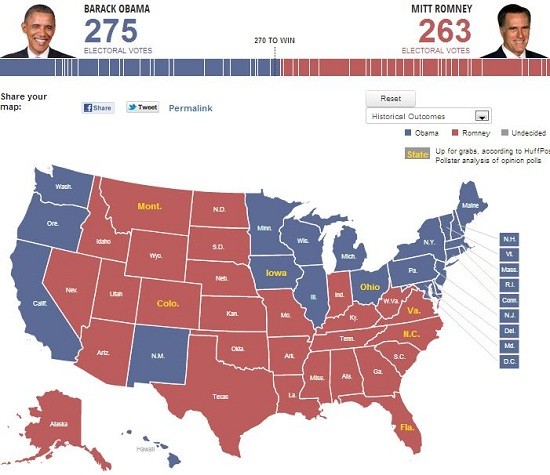
electoral projection october five
What was the plan, then? Hope for Jim Lehrer to pose the question, "What about Romney's gaffes?" Everyone who bothered to check knew that the debate format was six, 15-minute segments on a broad domestic policy topic. What you are supposed to do with that is bend the conversation back around to the salient points you want to make about your opponent. One of the topics was a catch-all discussion on each candidate's opinion on the "role of government" in the lives of Americans. That would have probably been a good moment to point out that Romney said, "It's not my job to worry about those people."
ROMNEY BEATS THE GOP ESTABLISHMENT: Last week, we told readers that if they really wanted to find signs of Romney's imminent demise, they should dismiss the media consensus and instead study the actions taken by various conservative factions -- beginning first and foremost with those who control and direct large amounts of campaign money. The clearest sign that Romney is in trouble is if that money starts getting directed down ticket, in an attempt to preserve and obtain legislative majorities in the face of an imminent Obama win.
Going into Wednesday's debate, here's one of the news stories that greeted Romney,from Fox Business' Charlie Gasparino:
The Romney campaign is experiencing what some officials believe could be the beginning of a mass exodus of big money donors diverting their cash away from the Republican presidential hopeful and toward Republican candidates for the House and Senate races more likely to win in November, the FOX Business Network has learned.
The first benefit of Romney's debate victory is that he's going to forestall this, and keep those donors at home. The second benefit of Romney's debate victory? It's going to put the kibosh on all of the endless carping and armchair quarterbacking from conservative pundits and activists that had Ann Romney yawping, "Get in the ring." As Steve Kornacki put it:
All of this destructive chatter ceased Wednesday night, and the right is now re-energized, believing once again that the White House is winnable. We’ve seen something like this happen before: Remember the jubilant reaction of Democrats on September 30, 2004, when John Kerry – whom they’d all but given up for dead – turned in a command debate performance against a listless George W. Bush?
So, any lingering doubts? Perhaps. As Molly Ball noted, "The debate's most significant development was the unequivocal debut of a moderate, pragmatic Romney -- the Romney who governed Massachusetts and has rarely been seen since his 2007-era reinvention as an archconservative." And that's not sitting well with everyone on the right. Here's Philip Klein:
Another reason for caution is that Romney, as part of his efforts to disarm Obama’s criticisms, made a number of policy concessions that could box him in and make it more difficult for him to govern as a limited government conservative if elected. At various times during the debate Romney said that he wasn’t interested in cutting taxes, particularly on the wealthy; that he would cover individuals with pre-existing conditions; that he wouldn’t touch Medicare and Social Security over the next decade and would be willing to give more money to seniors for prescription drugs; and that he’d be open to hiring more teachers. Should he be elected president, all of the major fights –- repealing Obamacare, overhauling the tax code and reforming entitlements – will trigger a massive campaign by liberals to portray him as trying to hurt the poor to the benefit of the rich. If he is so willing to concede policy points during the campaign, will he fight for limited government as president?
Mike Riggs adds: "In other words, Romney “won” by promising big-government conservatism in the vein of George W. Bush. Actual conservatives should be furious and very worried."
Maybe so. But we think that actual conservatives mostly would just like to win the election. They have, for the most part, allowed Romney to operate without pinning him down on whether he plans to be the hand of transformative austerity or a closet-Keynesian.
THIS WAS NOT A ROMNEY LIE, BY THE WAY: Over at Rolling Stone, Tim Dickinson rounds up "Mitt Romney's Five Biggest Lies." We think he might have fallen one short, however:
"We've got 23 million people out of work or [who have] stopped looking for work in this country." Romney is lying for effect. The nation's crisis of joblessness is bad, but not 23 million bad. The official figure is 12.5 million unemployed. An additional 2.6 million Americans have stopped looking for jobs. How does Romney gin up his eye-popping 23 million figure? He counts more than 8 million wage earners who hold part-time jobs as also being "out of work."
Careful now. It's pretty glib to be able to say that those 8 million Americans who are holding down part-time jobs are not "out of work," but have you met any of those people? The simple fact of the matter is that lots of Americans are struggling to get by on part-time employment, and those who do show up in the U6 unemployment numbers as "underemployed" -- are people who want to be working full-time, but can only find part-time work. Part-timers, in addition, don't take home important benefits like employer-provided health care or paid sick leave.
Naturally, we've noted that as the U4 employment numbers started to get relatively rosier, critics of the Obama administration suddenly became super-interested in the U6 numbers. (That is, up until Friday, when they unleashed an embarrassing display of craze-faced conspiracy-mongering on the Bureau Of Labor Statistics latest jobs report.) You can bet your sweet bippy that if Romney wins election, all that renewed interest in the U6 numbers will fade, if we let it. But as long as they've brought it up, we should maintain an interest in it, because it tells the story of the fragile employment arrangements that many Americans are enduring.
So, go ahead and call Romney insincere or disingenuous in bringing this up, but don't call this a lie. It's not. It's all too real for millions of Americans struggling to get by on less.
ELECTORAL PROJECTION: It's time once again for your Speculatroners to end the week with our trademarked Electoral College projection, which is -- as always -- a mix of careful poll study, analysis of prevailing economic trends, pundit speculation, and a meeting in a Rosslyn, Va., parking garage with the guy who runs the "X-Files" section at the Bureau of Labor Statistics.
People like backing winners, and so we expect that Romney is going to get something of a bounce from his debate win. People also like economic recovery, and Friday's jobs report could blunt Romney's bounce in a material way. But we don't have the numbers in front of us to be certain how much the race will close. As First Read points out, none of us do: "They will be PLENTY of polls for everyone to see. But realistically, the first polls you should trust that will absorb the ENTIRE impact of the debate and post-debate are the runs released no sooner than Tuesday… You want surveys that were actually in the field Sunday and Monday."
But we obviously can't wait for Tuesday to make some kind of half-assed guess about the electoral college today, can we? So we'll generically assume that the race will tighten, and many of the battleground states -- Colorado, Virginia, Florida, and Nevada -- are going to be back or near-to-being-back in Romney's column some time next week. But Obama's firewall in Ohio remains intact. We sure hope Ohioans aren't yet sick to death of political advertising, because that is precisely what is going to consume their lives for the next month.


Edited By Cen Fox Post Team

Hot Babes In Bikinis

"Foxy Megan"

Focus On Terrorism!

Who Won Round 2?

Students March In Madrid

'Today' Shows Staffers Split

Addicted To Exercise!